
By Global Consultants Review Team ,
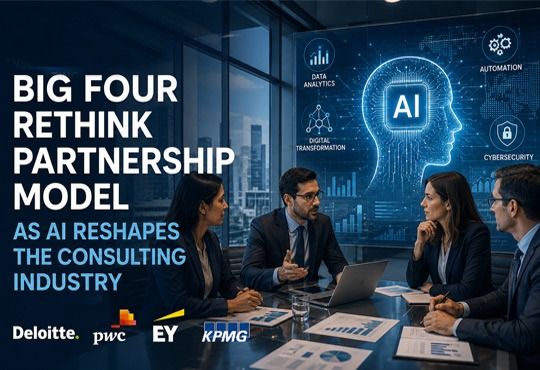
Artificial intelligence is rapidly transforming the global consulting industry, prompting several of the world's largest professional services firms to reconsider decades-old partnership structures. According to reports emerging today, the Indian operations of major consulting networks—including Deloitte, PwC, and EY—have significantly expanded their senior leadership ranks as demand for technology consulting continues to outpace traditional advisory services.
The shift reflects a broader evolution across the consulting sector. Rather than relying primarily on audit, tax, and transaction advisory, firms are increasingly generating revenue from AI implementation, cloud transformation, cybersecurity, and enterprise digital modernization. This transition is also changing how consulting firms recruit talent, reward performance, and develop future leaders.
Industry analysts note that technology consulting has become one of the fastest-growing segments within professional services. As organizations accelerate investments in generative AI, automation, and digital transformation, consulting firms are hiring specialists in machine learning, data engineering, cybersecurity, and AI governance at an unprecedented pace.
One notable trend is the expansion of senior leadership roles. Firms are promoting more professionals into partner and executive director positions to manage increasingly complex client engagements across sectors such as banking, healthcare, manufacturing, retail, and public services. This reflects not only rising client demand but also the need for specialized expertise capable of guiding enterprise-wide AI adoption.
However, the rapid rise of AI is also creating strategic challenges. Many of the analytical and presentation tasks traditionally handled by junior consultants can now be completed with advanced AI tools, prompting firms to redesign career pathways. Instead of focusing solely on manual research and report preparation, consultants are expected to combine industry knowledge with AI-assisted decision-making and technology implementation skills.
Consulting firms are responding by investing heavily in proprietary AI platforms, employee training, and strategic acquisitions. Rather than viewing AI as a threat, many see it as an opportunity to expand higher-value advisory services, helping clients redesign business processes, improve productivity, strengthen cybersecurity, and modernize operations.
The industry's business model is evolving as well. Traditional consulting engagements centered on strategy recommendations are increasingly being replaced by end-to-end transformation projects that include AI deployment, cloud migration, data modernization, and continuous optimization. Clients now expect consultants not only to advise but also to implement and manage technology-driven change.
Experts believe this transformation could permanently reshape the consulting profession. Partnership models designed for audit and traditional advisory businesses may no longer fit organizations whose fastest-growing practices revolve around software engineering, AI development, and digital product innovation. As a result, firms are exploring more flexible leadership structures capable of attracting highly specialized technical talent while maintaining the collaborative culture associated with partnerships.
The consulting industry's evolution is also influencing competition. Technology consulting firms, cloud providers, AI startups, and traditional management consultancies are increasingly competing for the same enterprise transformation projects. This convergence is encouraging partnerships, acquisitions, and investments that blend strategic advisory with technical execution.
Artificial intelligence is no longer just another consulting service—it is becoming the foundation on which the next generation of consulting firms will build their growth strategies.
As enterprises continue accelerating AI adoption throughout 2026, consulting firms are expected to further expand their technology capabilities while refining leadership models to support a more digital, skills-driven future. The firms that successfully combine strategic advice with deep technical execution are likely to gain the strongest competitive advantage in the evolving consulting marketplace.
We use cookies to ensure you get the best experience on our website. Read more...




.jpg)